
Balance on Your Plate – Eating for Sattva
Finding a little more harmony, one delicious mouthful at a time.
In her recent blog, Lisa introduced us to the three gunas — Sattva, Rajas and Tamas — the qualities that, according to yogic philosophy, influence our energy, thoughts and the way we experience the world.
But have you ever considered that these same qualities might be reflected in the food we eat? After all, the concept “you are what you eat”, is hardly new, is it?
In the yogic tradition, food is more than simply fuel for the body. It is also believed to influence how we feel, how we think and how we move through our day.
And this is where Sattva comes to the table.
So, What Does Sattva Taste Like?
Sattva is associated with clarity, harmony, lightness and contentment.
In traditional yogic thinking, sattvic foods are fresh, seasonal, nourishing and prepared with care. They’re generally simple, gently cooked and easy to digest.
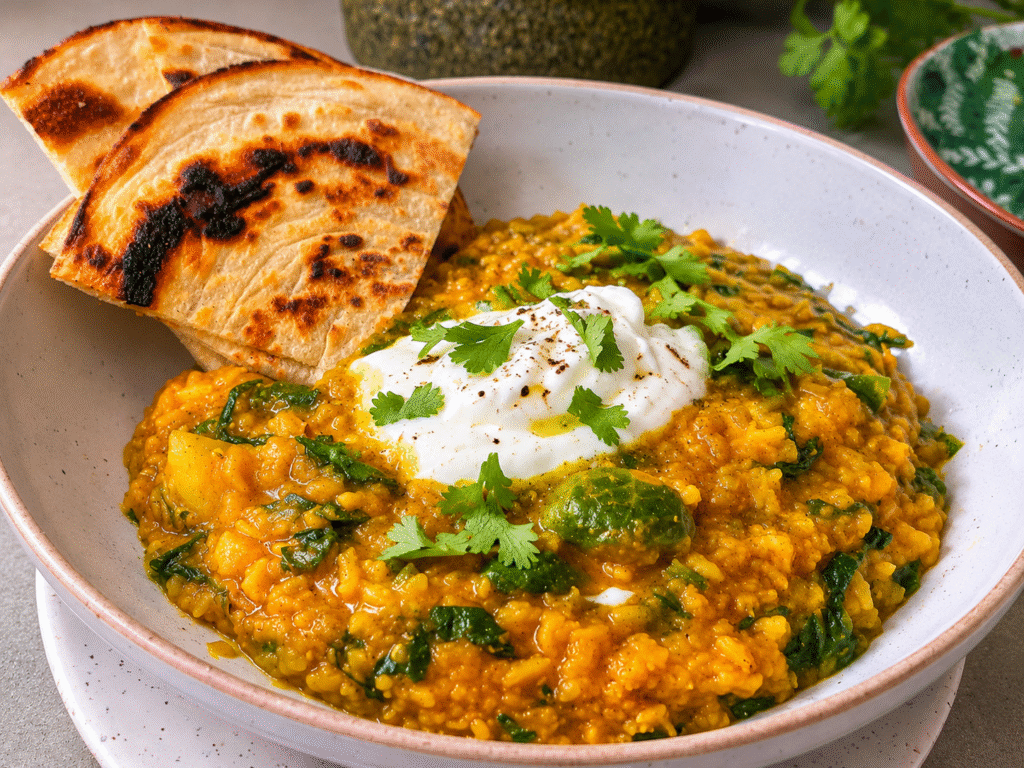
Think of a bowl of warm dhal, freshly steamed vegetables and fragrant basmati rice (I’ll include a recipe) or just a plate of colorful seasonal fruit.
Nothing fancy. Nothing complicated.
Just honest food that leaves us feeling comfortably nourished rather than overly full.
Bringing Sattva Into Your Kitchen
The wonderful thing about sattvic eating is that many of the ingredients are probably already sitting in your pantry or fridge.
Fresh fruit and vegetables
Colourful, seasonal produce forms the heart of sattvic eating. Pumpkin, leafy greens, zucchini, carrots, apples, pears and berries are all lovely choices.
Whole grains
Rice, quinoa, oats and barley provide a nourishing foundation for simple meals.
Legumes
Mung beans, lentils and chickpeas can be transformed into comforting dhals, soups and nourishing bowls.
Nuts and seeds
Almonds, sesame seeds, pumpkin seeds and other nuts and seeds add texture, flavour and nourishment.
Gentle spices
Turmeric, coriander, cumin, fennel and cardamom bring warmth and fragrance without overwhelming a dish.
And perhaps most importantly, food is traditionally considered more sattvic when it’s freshly prepared and enjoyed with appreciation. Perhaps the ritual of ‘grace’ had a profound effect on our digestive systems.
What About Rajas and Tamas?
As Lisa explained, the three gunas are always present, continually shifting and influencing one another.
Traditionally, very spicy, stimulating or strongly flavoured foods are associated with Rajas — the quality of activity and movement.
Heavy, stale or excessively processed foods are often associated with Tamas — the quality of inertia and heaviness.
But before you start worrying about your morning coffee or that lovely piece of chocolate, remember that these are philosophical ideas, not strict nutritional rules.
Food should never become another source of stress.
We can enjoy the occasional indulgence while still making choices that support our wellbeing.
After all, balance is what we’re looking for.
A Little Sattva on Your Plate
Here’s a simple meal idea that captures the spirit of sattvic in an AYURVEDIC Lentil Bowl
Imagine a bowl of soft, gently spiced red lentils, fluffy basmati rice, steamed greens and some coconut yogurt.
Simple ingredients, healing spices, thoughtfully prepared and full of flavour.
It’s the kind of meal that invites you to slow down and savour every mouthful, because you KNOW its good for you.
Perhaps It’s Also About How We Eat
We can prepare the most beautiful, nourishing meal, but if we eat it standing at the kitchen bench, scrolling through our phones or rushing to the next appointment, have we really given ourselves the opportunity to enjoy it?
Sattva invites us to consider not only what is on our plate, but how we approach the experience of eating.
Perhaps we sit outside.
Perhaps we share a meal with a friend.
Perhaps we simply put our phones away and take a moment to appreciate the food in front of us.
There is something rather lovely about turning an ordinary meal into a small moment of mindfulness.
Here is a small ritual that promises better digestion-
Take your bowl/plate in your hands.
Gaze at the food for at least 10 seconds and give thanks for what you are receiving
Smell the food 3 times. Try and notice different aromas.
Begin to eat slowly, finish each mouthful completely before taking another.
Finding Your Own Balance
At Meet Move Eat, we believe food is one of life’s great pleasures.
It’s about nourishment, certainly, but it’s also about connection, creativity, sharing and joy.
Exploring sattvic eating doesn’t mean following a rigid diet or giving up everything we love.
It’s simply an invitation to become a little more aware of our choices.
To choose fresh food more often.
To cook with care.
To eat with appreciation.
And perhaps to notice how different foods leave us feeling.
Because sometimes, finding a little more balance in life can begin with something as simple as what’s on our plate.
Meet. Move. Eat.
Move with intention. Eat with joy. Live with balance.
