
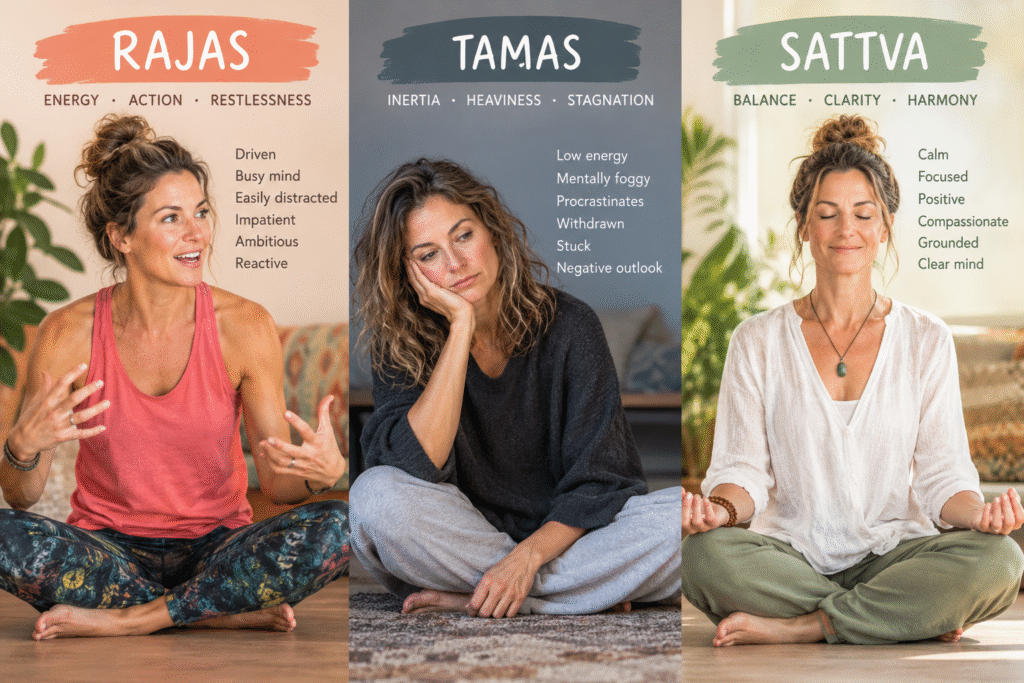
Some days your mind is a browser with forty tabs open. Other days it feels like wading through wet sand, and even getting off the couch takes effort. Both are ways of being human, and yoga has a beautiful framework for understanding them: the gunas.
What are the gunas?
In yogic philosophy, everything in nature, including our bodies, moods and minds, is made up of three qualities, or gunas. They are always shifting, and none is “bad”. They simply tell us something about where we are right now.
- Sattva is balance, clarity, steadiness and ease. It’s the feeling of being grounded, present and at home in yourself.
- Rajas is movement, energy and agitation. In balance, it’s motivation and drive. Out of balance, it’s restlessness, racing thoughts, tension and overwhelm.
- Tamas is heaviness, stillness and inertia. In balance, it’s rest and deep sleep. Out of balance, it’s fog, lethargy, numbness and disconnection.
The aim isn’t to get rid of rajas or tamas. It’s to notice which one is running the show, and to use your breath and movement to bring yourself back towards sattva.
Anxiety, depression and the gunas
This is a lens, not a diagnosis. Everyone’s experience is different, and many people swing between states in a single day. That said, you might recognise some patterns.
Anxiety often shows up as rajas. The mind speeds up, the breath gets high and shallow in the chest, the body feels wired, jittery or braced.
Depression often shows up as tamas. Energy drops, the body feels heavy, motivation fades, and the breath can become flat and sluggish.
Some of us live in a mix of both, wired and exhausted at the same time. Knowing which quality is dominant today tells you what your body needs.
Breathing for your guna
Breath is the most direct tool we have for shifting the nervous system, and you can use it anywhere.
If you’re feeling rajasic (anxious, wired, racing): the goal is to slow down and settle.
- Lengthen your exhale. Breathe in for a count of four and out for a count of six or eight. A longer exhale signals safety to the nervous system.
- Bhramari (humming bee breath). Breathe in through the nose, then hum on a slow exhale. The vibration is wonderfully soothing.
- Nadi shodhana (alternate nostril breathing) to balance and steady the mind.
If you’re feeling tamasic (heavy, flat, foggy): the goal is to gently awaken.
- Emphasise the inhale. Breathe in a little deeper and fuller than you breathe out, expanding the ribs and chest.
- Three-part breath, filling belly, ribs and then chest, to bring warmth and spaciousness back.
- Breath of joy, an energising practice that uses arm movements with a few quick inhales and one big exhale (skip it if you’re pregnant or have high blood pressure).
To rest in sattva: try sama vritti, or equal-ratio breathing. Inhale for four and exhale for four, smooth and even, like a quiet tide.
A gentle note: if you’re prone to anxiety, avoid forceful breathing or long breath holds. Keep everything soft and comfortable, and stop if you feel dizzy or more agitated.
Shapes (asana) for your guna
Calming rajas. You want grounding, folding and supported shapes that draw the energy inward and down.
- Child’s pose
- Seated or standing forward folds, with bent knees as needed
- Legs up the wall
- Supported bridge, with a block or bolster under the hips
- Slow cat-cow, moving with the breath
- Savasana, with something soft over your eyes
Lifting tamas. You want shapes that open the chest, build warmth and bring you back into the body.
- Mountain pose, with a deliberate lift through the crown of the head
- Warrior II and other standing poses that ask you to take up space
- Gentle sun salutations
- Bridge pose and low backbends such as sphinx or cobra
- Side stretches and heart-opening shapes, such as clasping your hands behind your back
Meeting sattva. When you’re closer to balance, shapes like tree pose, easy seat and gentle twists help you stay there. They invite steadiness and quiet awareness.
Most of these can be adapted for a chair, so no one is left out of the practice. You can find a version of each shape that works for your body, your energy and your day.
A simple practice to try
- Pause and ask: do I feel more wired (rajas) or more heavy (tamas)?
- Choose your breath from the lists above and give it two or three minutes.
- Move through two or three shapes that match what you found.
- Finish with a few rounds of even breathing, just noticing what has changed, even a little.
Yoga is support, not a substitute
Yoga can be a powerful companion for anxiety and depression. Research suggests regular practice can help with stress regulation and mood. But it’s one part of care, not a replacement for professional support. If you’re struggling, please reach out to your GP or a mental health professional. In Australia, you can call Lifeline on 13 11 14 or Beyond Blue on 1300 22 4636 at any time.
Be kind with yourself. Some days you’ll land in sattva easily, and other days you’ll simply notice where you are. That noticing is the practice.
Work with Lisa one-on-one
Meet Move Eat co-founder, Lisa Flower has completed Mental Health Aware Yoga training from the Yoga Psychology Institute under the guidance of Dr Lauren Tober. Lisa uses Mental Health Aware Yoga principles in some of her yoga sessions and in private yoga sessions. These sessions are designed to work alongside your therapist, not replace them, so your yoga practice can support the care you’re already receiving.
To enquire, contact Lisa on 0413 638 482.
